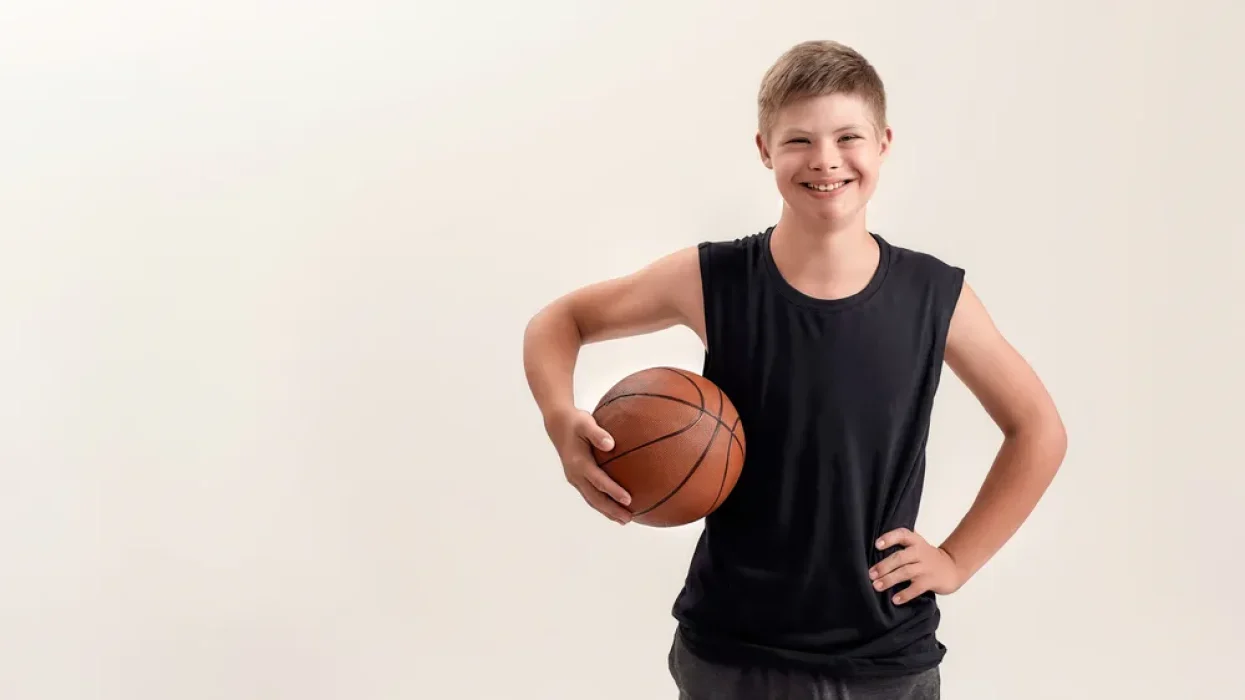
For some children, confidence in sports does not begin with winning a game or scoring the most points. It begins with one small moment of success.
A child catches a ball that felt difficult last week. They complete three basketball dribbles instead of one. They finish an obstacle course without asking to stop. Or, after missing a shot, they decide to try again.
Those moments matter.
Self-confidence in children with special needs can grow when sports provide achievable challenges, repeated practice, meaningful choices, visible progress, and opportunities to recover from mistakes. Simply participating in sports does not automatically create confidence. The environment, coaching style, level of challenge, and child’s individual needs all influence the experience.
Physical activity also has well-established health benefits for children. The CDC’s current guidance on physical activity for children highlights benefits related to muscular fitness, bone health, cardiovascular health, brain health, attention, and memory. For children and adolescents with disabilities, federal guidance recommends being as physically active as their abilities allow and working with appropriate healthcare or physical-activity professionals when individualized guidance is needed.
What Does Self-Confidence Look Like in a Child With Special Needs?
Confidence does not always look like running onto a field without hesitation.
For one child, confidence might mean asking the coach to try again. For another, it might mean participating beside another child for five minutes longer than last week.
You may see confidence growing when a child:
- attempts an unfamiliar movement
- asks for help instead of immediately giving up
- returns to an activity after making a mistake
- completes part of a drill independently
- remembers the next step without prompting
- accepts feedback more comfortably
- asks to make an activity harder
- recognizes their own improvement
- begins talking positively about what they can do
This is an important distinction when parents want to build confidence in special needs children.
The goal is not to make every child competitive, outgoing, or fearless. It is to help them develop enough trust in their abilities to try, learn, adapt, and recognize progress.
Why Can Traditional Sports Feel Difficult for Some Children?
Traditional team sports can be excellent for many children. They offer movement, friendship, teamwork, structure, and competition.
But one format does not fit every learner.
Research on physical activity among children with disabilities has repeatedly identified factors such as program accessibility, staff knowledge, opportunities for participation, family support, previous experiences, and the way activities are structured as possible barriers or facilitators. A recent 2026 umbrella review similarly found that adapted activities, supportive environments, autonomy, social connection, and appropriate interventions can influence active participation among children and youth with disabilities.
Instructions may move too quickly
Imagine hearing:
“Dribble to the cone, crossover, pass to your partner, run around the next cone, get the ball back, and shoot.”
One child may understand that immediately.
Another child may do better with:
“Dribble to this cone.”
Then:
“Stop here.”
Then:
“Pass the ball to me.”
The sport is the same. The learning process is different.
Comparison can replace progress
In traditional sports, children naturally notice who is faster, who scores more, who starts the game, and who already knows what to do.
For a child who is still learning fundamental skills, constant comparison may make their own improvement difficult to see.
Adaptive coaching can shift the question from:
“Am I as good as everyone else?”
to:
“Can I do something today that I couldn’t do before?”
Mistakes may feel too public
Missing a basketball shot during private practice feels very different from missing it while teammates, opponents, parents, and spectators are watching.
Children need opportunities to make mistakes. But they also need environments where mistakes feel safe enough to learn from.
Group coaches have limited individual time
A coach working with an entire team cannot always stop a drill, change equipment, simplify one instruction, repeat a demonstration, or let one child practice the same movement ten additional times.
For some children, beginning with one-on-one youth sports coaching at Fit First can provide more room for individualized pacing before they move into other sports environments.
How Do Sports Build Self-Confidence in Children With Special Needs?
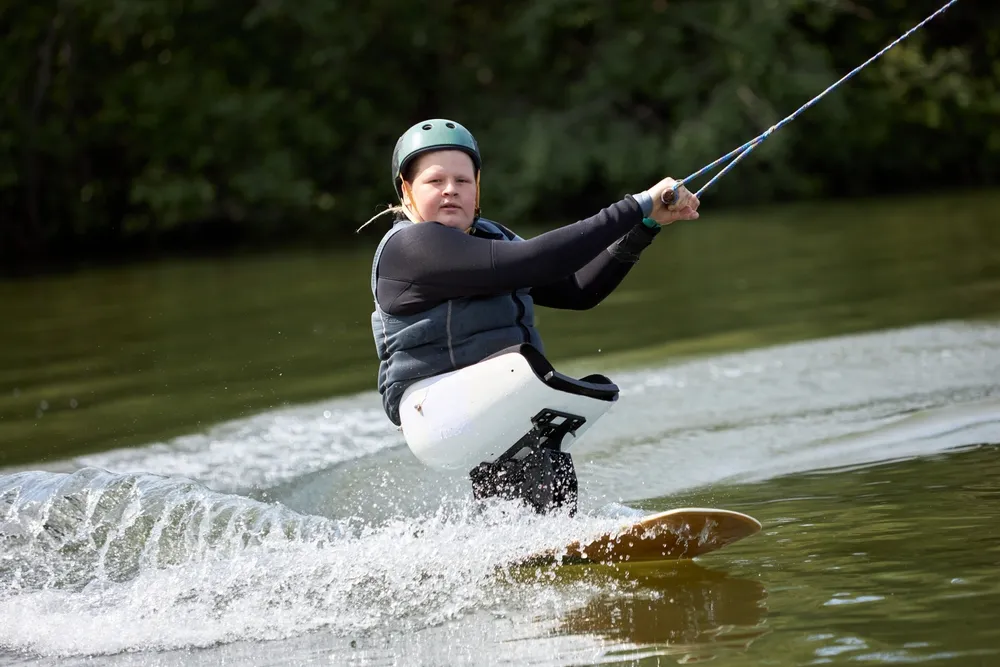
Sports can build confidence by giving children repeated evidence that abilities can change through practice.
That evidence is more powerful than simply telling a child, “You’re good at this.”
The confidence-building cycle often looks like this:
Challenge → Practice → Small Success → Recognition → New Challenge
1. Sports make progress visible
Physical skills are measurable.
Yesterday, a child could complete one controlled dribble.
Today, they complete three.
Later, they dribble while walking.
Eventually, they change direction while keeping control of the ball.
The child can see what changed.
Instead of hearing an adult say, “You’re getting better,” they can experience it themselves.
That creates a stronger foundation for self-belief.
2. Repetition turns unfamiliar movements into familiar skills
Children can hesitate when they do not know what will happen.
Will I catch the ball?
Will I lose my balance?
Will I remember the instructions?
What happens if I miss?
Appropriate repetition reduces some of that uncertainty.
A movement that originally required constant thought begins to feel more familiar. A child starts remembering the sequence, understanding the equipment, and anticipating what happens next.
Gradually, “I don’t know how” can become “I know what to do.”
3. The right level of challenge creates competence
Confidence-building activities should not always be easy.
A task that requires no effort provides little sense of accomplishment. But repeatedly asking a child to perform something far beyond their current skill level can create frustration.
Good adaptive coaching looks for the space between those extremes.
For example:
Step 1: Bounce a basketball once and catch it.
Step 2: Complete three controlled dribbles.
Step 3: Complete five.
Step 4: Dribble while walking toward a cone.
Step 5: Add a change of direction.
The activity is still basketball.
Only the entry point has changed.
That is one of the most important ideas behind adaptive sports for kids: adaptation should not remove meaningful challenge. It should make the challenge accessible enough for the child to participate and progress.
4. Sports give children opportunities to act independently
Physical activity involves constant small decisions.
Where should I stand?
How much force should I use?
Which direction should I move?
What comes next?
Should I try again?
Children can gradually take ownership of these decisions.
Independence might begin with setting up their own cone, remembering where a drill starts, choosing between two activities, or completing a familiar movement without prompting.
The U.S. Department of Health and Human Services’ Physical Activity Guidelines for Americans specifically encourages opportunities for young people with disabilities to participate in appropriate physical activity based on their abilities and individual circumstances.
5. Sports make mistakes useful
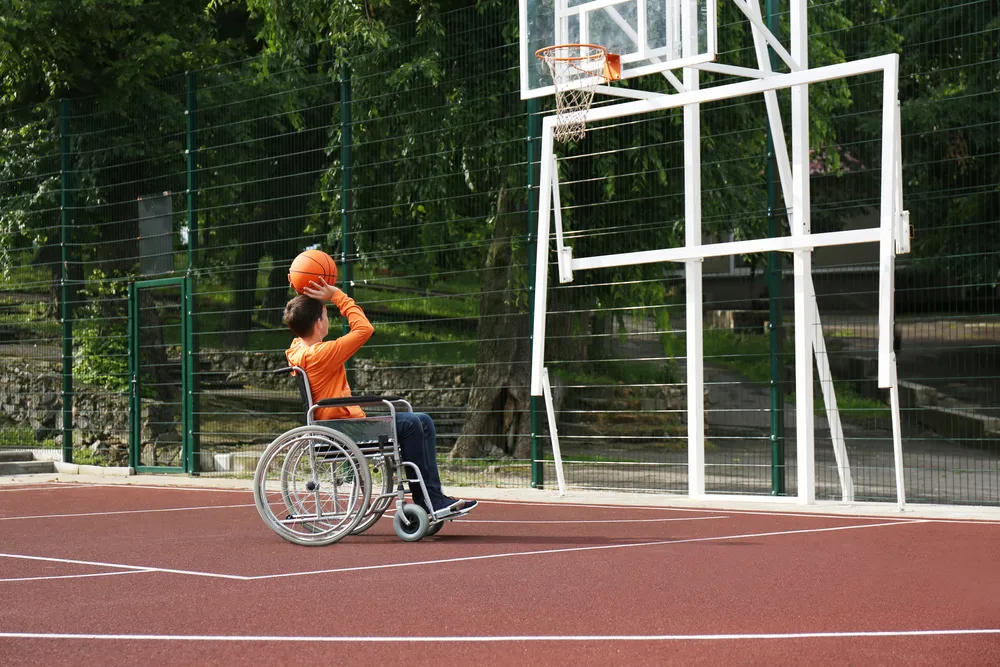
A missed shot provides information.
The ball went left.
Move your feet.
Adjust.
Try again.
The mistake does not need to become:
“I’m bad at basketball.”
A supportive coach can redirect the child toward problem-solving:
“That one went to the left. Let’s change your foot position and see what happens.”
The focus moves from judgment to learning.
This is one reason sports can become powerful confidence building activities for special needs children.
6. Learning physical skills can influence how children see their abilities
Self-confidence and self-esteem are related, but they are not identical.
Self-confidence is usually more specific:
“I believe I can do this.”
Self-esteem is broader and relates to how someone values and views themselves.
A meta-analysis of controlled studies involving children and adolescents found that supervised physical-activity interventions were associated with improvements in some measures of self-concept and self-worth, although effects varied by study design and setting.
Parents should not view sports as a treatment for low self-esteem in children with disabilities. But sports can create real experiences of competence:
“I learned that.”
“I finished it.”
“I tried again.”
“I can do more than I could before.”
Those are meaningful experiences for a developing child.
7. Sports create natural opportunities for social interaction
Social learning does not always need to happen in a formal lesson.
Sports naturally involve:
- taking turns
- sharing equipment
- communicating with a coach
- following another person’s lead
- cooperating toward a goal
- waiting
- encouraging another participant
- learning rules
- responding when something does not go as planned
Sports do not automatically improve every child’s social skills.
They simply create situations where communication and cooperation have an immediate purpose.
For children who benefit from a more individualized entry point, Fit First’s adaptive classes in Orange County can combine modified activities with opportunities to participate at an appropriate pace.
What Are Adaptive Sports for Kids?
Adaptive sports modify elements of an activity so a child can participate meaningfully while still experiencing an appropriate challenge.
A coach might change:
- equipment
- distance
- instructions
- group size
- rules
- pace
- number of repetitions
- rest periods
- visual cues
- complexity of a movement
For example, three children learning basketball might practice the same skill differently.
One child shoots from several feet away.
Another moves closer to the basket.
A third begins with controlled ball handling before adding shooting.
Everyone is learning basketball.
They simply have different starting points.
This individualized approach is central to Fit First’s adaptive fitness programs for children with special needs.
Traditional Team Sports vs. Adaptive Sports
| Factor | Traditional Team Sports | Adaptive or Individualized Sports |
| Pace | Usually follows the group | Can follow the child’s pace |
| Instruction | Shared with the whole team | Can be simplified or repeated |
| Skill progression | Often follows the program schedule | Can progress skill by skill |
| Coach attention | Divided across participants | More individualized |
| Competition | Often built into the activity | Can be introduced gradually |
| Environment | Usually predetermined | May be easier to modify |
| Success measurement | Scores, games, team outcomes | Personal progress and participation |
| Best fit | Children comfortable in group sports | Children who benefit from adaptation or added support |
Neither approach is inherently better.
Some children thrive in team sports. Others benefit from individual coaching first. Some may use both at different stages.
The right environment is the one where the child can participate safely, remain engaged, learn, and experience meaningful progress.
Why Can One-on-One Coaching Help Some Children Build Confidence?
One-on-one coaching removes many variables from the learning environment.
There is no teammate waiting for the drill to finish.
There is less pressure to keep up with another child.
The coach can observe exactly what happened and adjust immediately.
If the task is too difficult, it can be simplified.
If the child masters it quickly, the challenge can increase.
If verbal instructions are not working, the coach can demonstrate.
If the child needs more repetition, there is time for repetition.
Fit First’s personal training programs in Orange County are structured around individualized goals, skill development, flexible coaching, and progress at the child’s pace.
For some children, this can be an effective starting point before group activities. For others, one-on-one sports training may continue alongside team participation.
The Coach Matters as Much as the Sport
Basketball itself does not build confidence.
Neither does soccer, running, tennis, or an obstacle course.
The way the activity is taught matters.
An effective adaptive coach needs to recognize:
- when to challenge
- when to simplify
- when to demonstrate
- when repetition is useful
- when frustration is becoming counterproductive
- when a child needs a meaningful choice
- how to give specific feedback
Compare two responses:
“Great job!”
and:
“You watched the ball, kept both hands ready, and caught three passes in a row.”
The second response tells the child exactly what they did successfully.
That connection between child development and coaching is particularly relevant at Fit First. Founder and Head Coach Adam Krell’s professional profile lists a B.S. in Behavior Psychology with a specialization in Child Development and Special Education, experience as an elementary special-education teacher, NASM Advanced Trainer certification, and EMT-B certification. Parents can meet Adam Krell and the Fit First coaching team.
8 Confidence-Building Activities for Special Needs Children
Basketball target progression
Begin near the basket and gradually increase distance.
Why it can help: Progress is easy for the child to see.
Soccer cone course
Create a simple course with a clear beginning and end. Increase complexity only as control improves.
Why it can help: A predictable route makes success measurable.
Personal-best running challenge
Time a short course and compare the child with their own previous result rather than another child.
Why it can help: Improvement becomes personal rather than competitive.
Catch-and-throw progression
Begin close together. After several successful catches, take one step backward.
Why it can help: The challenge grows gradually.
Balance course
Use safe lines, floor markers, stepping points, or appropriate balance equipment.
Why it can help: Children can feel and see improvements in body control.
Movement-choice game
Ask:
“Would you like to do basketball or the obstacle course first?”
Why it can help: The child participates in choosing the session.
Obstacle course
Combine appropriate movements such as walking, stepping, throwing, crawling, balancing, or jumping.
Why it can help: The activity has a clear start, sequence, and finish.
Cooperative challenge
Instead of asking who can complete the most passes, ask:
“Can we make ten passes together?”
Why it can help: Another participant becomes a partner rather than a competitor.
What Are the Best Sports for Special Needs Kids?
There is no single best sport for children with special needs.
A better question is:
Which activity matches this child’s interests, abilities, goals, and preferred learning environment?
Possible activities include:
- basketball
- soccer
- swimming
- tennis
- pickleball
- running
- martial arts
- cycling
- yoga
- general fitness
- obstacle courses
- modified team games
Basketball can work well when a child responds to skills that can be divided into small steps.
Running may appeal to children who enjoy working toward personal goals.
A child who enjoys predictable routines may prefer an activity with consistent sequences.
Another child may be most motivated by social games.
Do not select a sport simply because it is commonly recommended for a particular diagnosis.
Select it for the child.
The American Academy of Pediatrics’ clinical report on sports and physical activity for children and adolescents with disabilities similarly emphasizes considering the child’s preferred activities, functional abilities, needed adaptations, and available opportunities.
How Parents Can Help Build Confidence Outside Sports Sessions
The question parents ask after practice can influence what children believe mattered.
Instead of:
“Did you win?”
try:
“What did you learn today?”
Instead of:
“Were you the best?”
try:
“What became easier?”
Other useful questions include:
- What are you proud of?
- What did you keep trying even though it was difficult?
- Which activity would you like to do again?
- What would you like help with next time?
- Did anything feel easier than last week?
Specific encouragement can also be more useful than general praise.
“You missed twice and still tried a third time.”
gives a child something real to recognize.
How Can You Tell Whether a Sports Program Is Building Confidence?
Parents should look beyond scores and athletic performance.
Signs of progress may include a child:
- becoming more willing to attend
- attempting unfamiliar movements
- asking for another try
- remaining involved for longer
- communicating more comfortably with the coach
- independently preparing equipment
- recovering more easily after mistakes
- talking about something they learned
- asking to try a harder variation
- expressing pride in improvement
Progress is rarely perfectly linear.
One frustrating day does not mean the program is failing.
Look at the pattern over time.
What If Your Child Says, “I’m Not Good at Sports”?
Parents naturally want to answer:
“Yes, you are!”
But general reassurance may not change what the child believes.
Try creating evidence instead.
If basketball feels impossible, begin with:
“Let’s see if we can do two controlled dribbles.”
Then four.
Then six.
Then three steps while dribbling.
The child no longer needs to believe a vague statement that they are “good at sports.”
They have proof that they learned something.
That distinction is central to building self-confidence in children with special needs.
Adaptive Sports for Kids in Orange County
Families throughout Orange County may be comparing team sports, private coaching, adaptive fitness, or smaller-group activities.
Fit First currently provides youth sports and fitness programs in multiple Orange County communities, with individualized and special-needs-friendly options available depending on the program and location.
Families can explore:
- youth sports and special-needs training in Irvine
- youth fitness and adaptive training in Newport Beach
- adaptive classes across Orange County
- one-on-one Fit First training
A child does not need to begin by joining a large team.
Sometimes the right starting point is one coach, one activity, and one achievable goal.
Help Your Child Find the Right Starting Point
If your child has struggled in traditional sports, the answer may not be giving up on movement.
A different coaching environment can create a different experience.
Fit First can help families explore individualized sports, fitness, adaptive coaching, and one-on-one training based on the child’s interests and current comfort level.
Explore Fit First’s one-on-one training options or review current adaptive programs in Orange County.
Frequently Asked Questions
How do sports build self-confidence in children with special needs?
Sports can create repeated opportunities for children to practice skills, solve small problems, experience progress, make choices, and recover from mistakes. Confidence is most likely to grow when the challenge matches the child’s abilities and progress is measured against their own previous performance rather than constant comparison with others.
Can sports improve self-esteem in children with disabilities?
Physical activity may support aspects of self-concept and self-worth. A meta-analysis of controlled studies found positive effects for some self-related outcomes in children and adolescents. However, sports should not be presented as a treatment or guaranteed solution for low self-esteem.
What are adaptive sports for kids?
Adaptive sports modify the way an activity is taught or performed so a child can participate meaningfully. Coaches may adjust equipment, rules, instructions, distance, pacing, group size, repetition, or complexity while preserving an appropriate level of challenge.
Are team sports good for children with special needs?
They can be. Some children thrive in teams and enjoy competition and peer interaction. Others may benefit from private or small-group coaching first. The right choice depends on the individual child, coaching environment, activity, and available adaptations.
Is one-on-one coaching better than group sports?
Not universally. One-on-one coaching may provide more individual attention, repetition, flexible pacing, and reduced social comparison. Group programs can provide additional opportunities for teamwork and interaction. Some children benefit from using both formats.
What are good confidence building activities for special needs children?
Basketball target challenges, soccer cone drills, catch progressions, balance courses, obstacle activities, personal-best running challenges, movement-choice games, and cooperative partner activities can all provide measurable opportunities for success when appropriately adapted.
How can parents build confidence in special needs children?
Focus on specific progress instead of comparison. Give manageable challenges, recognize effort and strategy, allow meaningful choices, and ask children what they learned or became better at rather than focusing only on results.
What sports are best for special needs kids?
There is no universal best choice. Basketball, soccer, swimming, running, tennis, martial arts, cycling, yoga, pickleball, obstacle courses, and general fitness can all be appropriate depending on the child’s interests, abilities, communication preferences, environment, and safety needs.
How long does it take sports to improve a child’s confidence?
There is no fixed timeline. Look for gradual changes such as willingness to try again, greater independence, longer participation, improved comfort with a coach, or pride in learning a skill instead of expecting an immediate personality change.
Where can I find adaptive sports for kids in Orange County?
Fit First provides private training, adaptive classes, sports, and special-needs-friendly youth fitness options across Orange County. Families can begin by reviewing Fit First’s adaptive classes in Orange County and current location-specific programs.
Confidence Starts With One Real Success
The most important outcome of youth sports is not always a trophy, a score, or a place on a team.
For some children, the breakthrough is realizing:
“I can learn something that used to feel hard.”
Meaningful self-confidence in children with special needs grows from evidence: appropriate challenges, patient practice, small accomplishments, supportive feedback, and opportunities to become more independent.
Sports can create those opportunities.
And sometimes the first step is simply finding a coach and environment that allow the child to experience success in their own way.