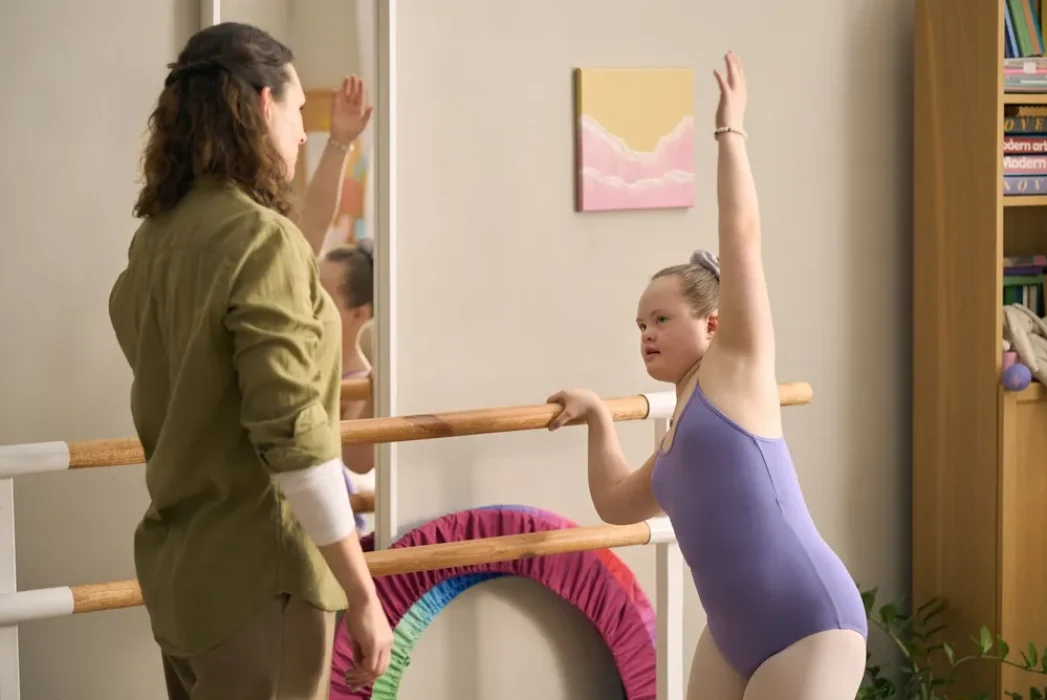
Some children are eager to move but do not feel comfortable in a conventional sports class. Fast instructions, large teams, unfamiliar routines, competitive pressure, or limited individual attention can make participation difficult, even when a child genuinely enjoys basketball, soccer, dance, or active play.
Adaptive classes for kids are sports and fitness experiences in which activities are modified to match a child’s current abilities, communication preferences, interests, and comfort level. A coach may adjust the pace, instructions, equipment, rules, group size, rest periods, or skill progression so the child can participate meaningfully while still experiencing an appropriate challenge.
That is the purpose of adaptive classes in Orange County: not to label children or remove every difficulty, but to give each child a more suitable way to experience movement, sports, and positive participation.
Fit First Family provides adaptive coaching, youth sports, private training, and small-group fitness experiences throughout Orange County. Depending on the child and program, that may mean learning a skill one-on-one, participating in cooperative activities with peers, or gradually developing the comfort needed to try a new sport.
What Are Adaptive Classes for Kids?
Adaptive classes change how a sport or physical activity is taught so a child can participate at an appropriate level.
In a traditional sports program, children may be expected to complete the same drills, follow the same instructions, and progress at approximately the same speed. An adaptive class provides greater flexibility.
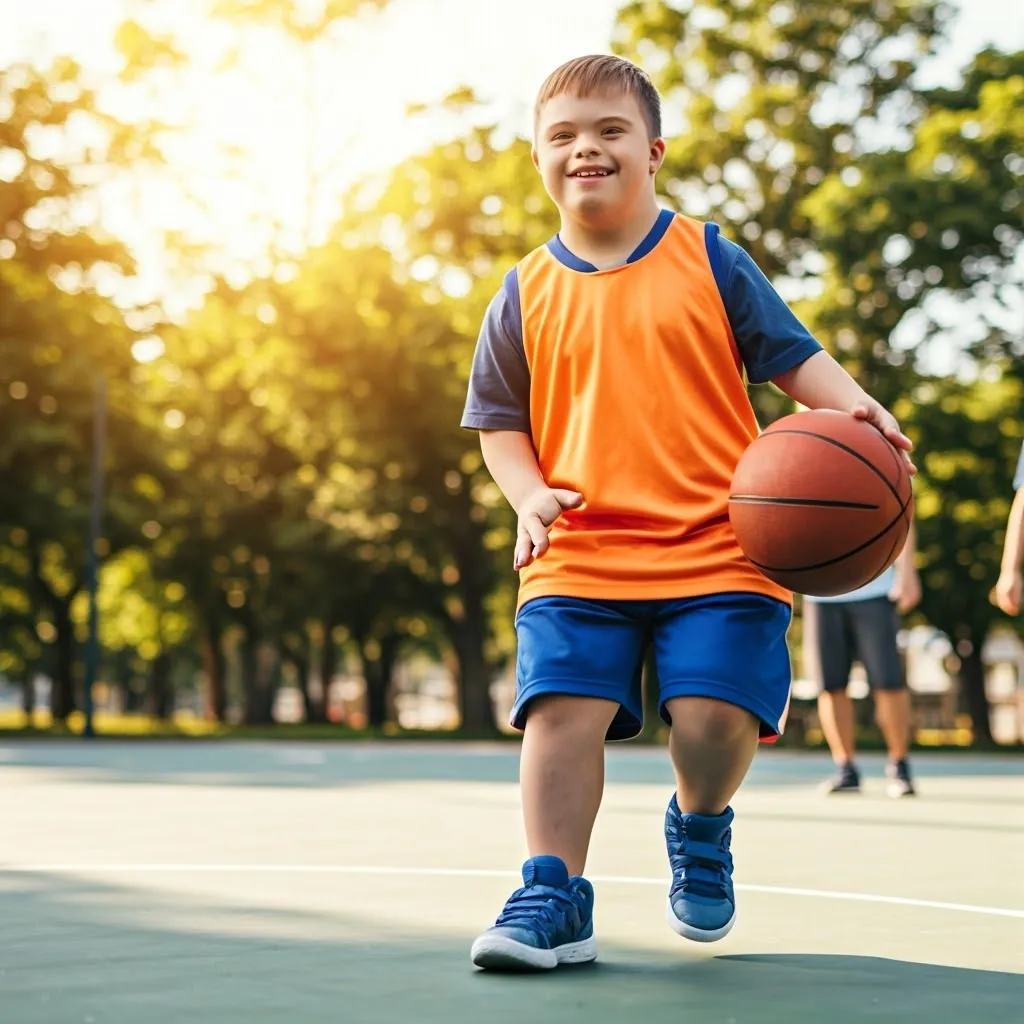
For example, a child practicing basketball might:
- Use a lower hoop
- Stand closer to the basket
- Receive one instruction at a time
- Practice with a lighter or larger ball
- Repeat partner passes before joining a game
- Take planned breaks between activities
The essential sport remains the same, but the path into it changes.
Adaptive coaching does not mean making every activity easy. It means adjusting the starting point, communication style, equipment, pace, or complexity while preserving meaningful participation and progressive skill development.
The U.S. Physical Activity Guidelines emphasize that young people should have opportunities and encouragement to participate in activities that are age-appropriate, enjoyable, and varied. Thoughtful adaptations can make those qualities more accessible to children who need a different starting point.
Who Can Benefit From Adaptive Fitness Classes?
Adaptive instruction is not limited to one diagnosis or one type of child. It may be helpful for a child who:
- Prefers additional individual attention
- Is new to organized sports
- Needs more time to process instructions
- Benefits from additional demonstrations or repetition
- Feels overwhelmed in a large group
- Responds well to predictable routines
- Wants to develop coordination gradually
- Benefits from modified activities or planned breaks
- Wants structured opportunities to participate with peers
Children with autism, ADHD, sensory needs, physical disabilities, or other developmental differences may also benefit from adaptive sports.
However, a diagnosis does not define a child’s abilities, interests, personality, or ideal coaching environment. Two children with the same diagnosis may have completely different communication preferences, physical interests, and comfort levels.
The American Academy of Pediatrics supports appropriate physical activity for children and teenagers with disabilities while recognizing that individual needs and accommodations matter. Parents can review its guidance on physical activity for children with disabilities and discuss their child’s needs directly with the program before enrollment.
Fit First’s Approach to Adaptive Youth Fitness
Parents need more than general promises about inclusion. They need to understand how a program can respond to their child in a real sports or fitness environment.
Fit First’s special-needs training program includes individual and small-group options, with activities adapted according to each child’s abilities, interests, and comfort level.
The approach centers on four practical principles.
Individualized instruction
Coaching begins with the child’s current skills and interests. One child may be ready to work on ball control, while another may first need time to become comfortable with the coach, space, or equipment.
Purposeful skill development
Adaptive coaching is more than supervised play. Sessions provide opportunities to practice movement, fitness, coordination, and sport-specific skills.
Positive, specific feedback
Children can be encouraged without being constantly compared with other participants. Feedback such as “You kept your eyes on the ball” or “You tried the sequence again” helps children understand exactly what they did well.
Opportunities for social participation
When appropriate, movement activities can provide natural opportunities to communicate, cooperate, wait for a turn, and participate alongside other children.
These are opportunities to practice interaction—not promises of a particular developmental outcome.
Sports Can Be About More Than Competition
Winning, scoring, and rankings are part of many sports, but they do not have to be the starting point for every child.
A sports activity can also provide structured opportunities to:
- Follow a short sequence
- Ask for help
- Work with a partner
- Wait for a turn
- Share equipment
- Try again after making a mistake
- Encourage a teammate
- Celebrate another child’s progress
Sports do not automatically create confidence or social development. The experience depends on the child, coach, environment, and level of challenge.
The American Academy of Pediatrics encourages families to protect enjoyment and avoid excessive performance pressure in youth sports. Its guidance about keeping physical activity fun and avoiding overtraining offers useful considerations for parents.
How Fit First Combines Sports and Socializing
Fit First’s Socializing Fitness program combines guided physical activity with small-group interaction.
Depending on the class and participating children, activities may include:
Partner exercises
Two children might pass a ball, mirror a movement, or complete alternating parts of a challenge.
Small-team activities
Participants can work through a relay or obstacle course in which every child contributes.
Turn-taking games
Children participate within a clear and predictable pattern of waiting, moving, and returning to the activity.
Cooperative challenges
The group works toward a shared goal instead of competing against one another.
Communication opportunities
Children may use words, gestures, signals, or agreed-upon cues to request equipment, begin an activity, or assist a teammate.
Special Olympics describes inclusive sports as an environment where participants with and without intellectual disabilities can work together and support social inclusion. This supports a careful conclusion: sports can create a shared activity around which interaction feels more natural, although they cannot guarantee a particular social outcome for every child.
Explore Fit First’s Socializing Fitness program.
One-on-One Adaptive Coaching
Private coaching can be valuable when a child benefits from:
- Maximum individual attention
- Flexible pacing
- Fewer distractions
- Additional repetition
- A predictable routine
- Gradual exposure to a new sport
- More time to build trust with the coach
A private session also gives the coach time to understand how the child responds to demonstrations, verbal instructions, choices, transitions, and changes in difficulty.
Private coaching does not have to be a permanent format. For some children, it can provide a comfortable starting point before participating in a small group.
Fit First’s one-on-one training for kids provides personalized coaching that can be adjusted around a child’s pace, interests, and goals.
Small-Group Adaptive Classes
Small-group classes offer a more dynamic environment. Children can practice physical skills while learning to navigate shared equipment, partners, changing turns, and team activities.
For a child who enjoys being around peers but feels lost in a large recreational league, a smaller group may offer a useful middle ground.
Potential benefits include opportunities to:
- Practice cooperation
- Participate in partner activities
- Learn alongside other children
- Take turns
- Communicate during an activity
- Use skills in a less predictable environment
Because the coach’s attention is shared, parents should ask about group size, coaching support, and how activities are modified for different participants.
Private and small-group coaching solve different challenges. Neither is automatically better.
| Factor | One-on-One Coaching | Small-Group Classes |
| Individual attention | Very high | High but shared |
| Social interaction | Primarily coach and child | Greater peer interaction |
| Pace | Highly individualized | Adapted within a group structure |
| Skill repetition | Easier to personalize | Balanced with group activities |
| Distractions | Typically fewer | More dynamic environment |
| Teamwork opportunities | Limited | Greater |
| Often suited for | Individual goals and gradual skill development | Sports skills and peer participation |
Why Child-Development Knowledge Matters in Coaching
Coaching a child is different from coaching an adult. Understanding the mechanics of a sport is important, but it does not automatically prepare a coach to work with a child who needs more processing time, becomes frustrated by unfamiliar tasks, or learns best through demonstration.
A child-development-informed coach may:
- Demonstrate a movement instead of relying only on verbal explanations
- Give one instruction at a time
- Maintain a predictable session routine
- Divide complex skills into smaller steps
- Allow additional practice before increasing difficulty
- Offer two meaningful choices
- Adjust an activity when frustration becomes counterproductive
- Build trust before introducing a more difficult challenge
Fit First founder and head coach Adam Krell’s published profile identifies a B.S. in Behavior Psychology with a specialization in Child Development and Special Education, experience as an elementary special-education teacher, and fitness credentials.
This background supports Fit First’s child-development-informed philosophy. Fit First is a sports and fitness provider, however, and its programs should not be represented as clinical therapy or medical treatment.
Parents can meet the Fit First coaching team and ask about the experience of the specific coach assigned to their child.
What Can an Adaptive Sports Session Look Like?
Every session may be different, but an adaptive class could include the following stages.
1. Welcome and transition
The coach greets the child, introduces the equipment, and explains what will happen during the session.
2. Movement warm-up
Simple mobility, balance, coordination, or movement games prepare the child for physical activity.
3. Individual skill practice
The child may practice throwing, catching, dribbling, footwork, balance, agility, striking, or another movement pattern.
4. Adapted challenge
The coach adjusts distance, repetitions, speed, complexity, or support according to the child’s response.
5. Social or cooperative activity
When appropriate, a partner or group exercise introduces passing, turn-taking, teamwork, or a shared objective.
6. Positive finish
The session concludes with an achievable challenge or an activity the child particularly enjoys.
7. Parent communication
A short conversation can help the parent and coach identify what worked, what was difficult, and what could be adjusted during the next session.
How Different Sports Can Be Adapted
Fit First offers activities including basketball, soccer, pickleball, boxing, martial arts, ninja and parkour, dance, yoga, fitness conditioning, and multi-sport training.
Possible adaptations include:
- Basketball: Lowering the hoop, reducing shooting distance, changing the ball, simplifying rules, or beginning with partner passing
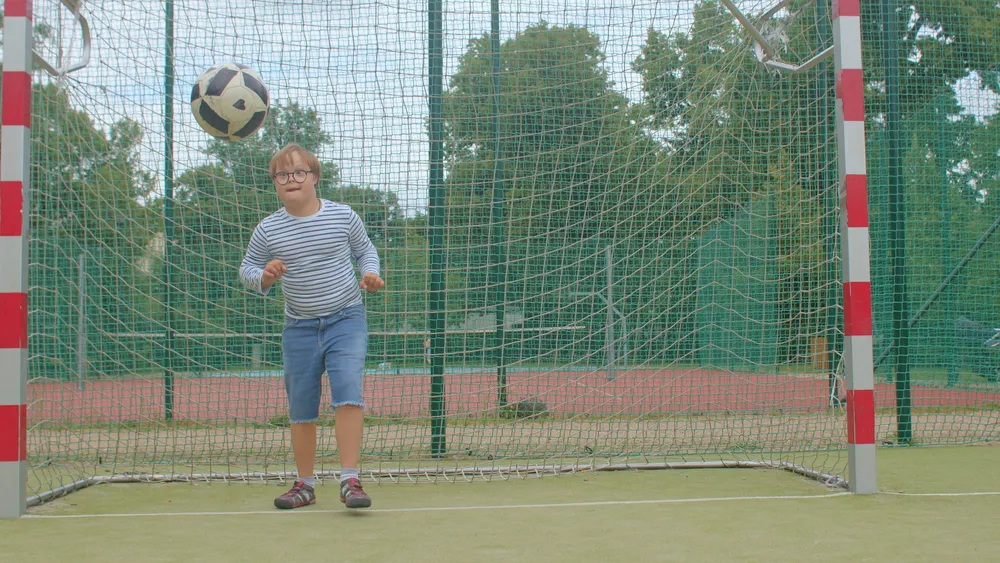
- Soccer: Using a smaller space, slowing the drill, practicing ball control individually, or introducing cooperative passing before gameplay
- Pickleball: Using a lighter or slower ball, shortening the court, allowing an additional bounce, or practicing paddle contact without scoring
- Boxing: Focusing on stance, footwork, and pad patterns; shortening combinations; and using visual cues or non-contact drills
- Ninja and obstacle activities: Changing obstacle height, sequence length, balance requirements, timing expectations, or coach support
- Dance and yoga: Reducing the number of steps or poses, demonstrating movements visually, repeating shorter sequences, or offering alternative positions
Adaptations should never be improvised at the expense of safety. Parents and coaches should agree on appropriate equipment, boundaries, and progression.
Movement and Socialization Can Work Together
Some parents want their children to exercise while also having comfortable opportunities to interact with peers.
Movement can make social interaction feel less abstract. Instead of sitting face-to-face and being told to “practice social skills,” children have something concrete to do together.
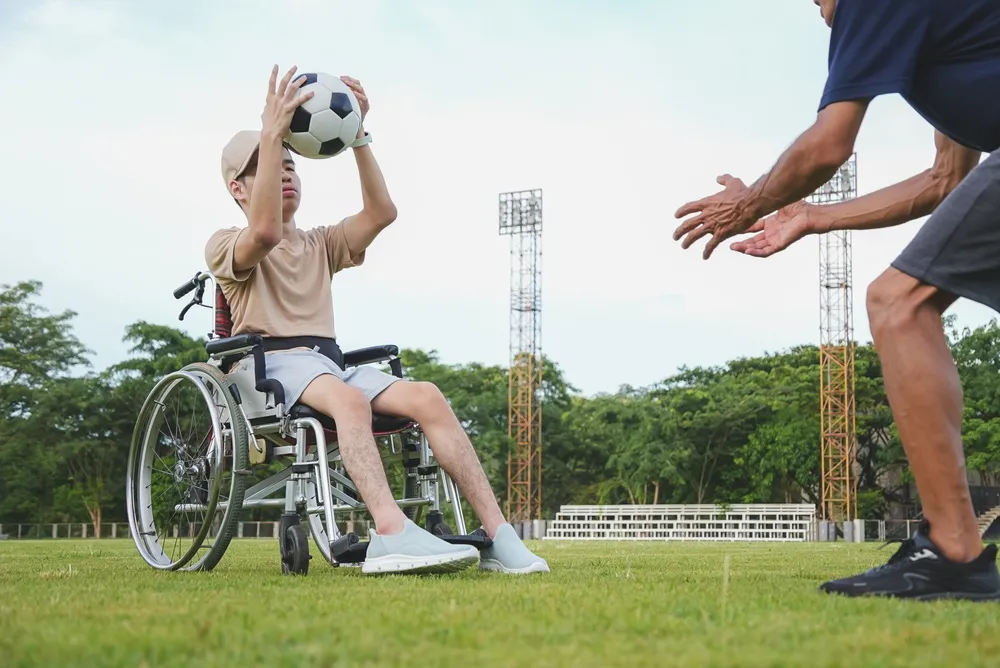
They can pass a ball, follow a teammate, request equipment, wait for a turn, choose a partner, encourage another participant, or complete a shared challenge.
The accurate expectation is that sports can provide structured opportunities for interaction. Children should not be pressured to communicate or participate socially in one predetermined way.
Building Confidence Without Unnecessary Pressure
Confidence is not developed by pretending every task is easy. A more useful pattern is:
Realistic challenge → achievable attempt → specific feedback → gradual progression
Small successes give children evidence of what practice can change. Repetition makes an activity more familiar, while meaningful choices provide a sense of control.
The coach’s role is not to remove all difficulty. It is to select a level of difficulty that requires effort without making participation feel impossible.
Adaptive does not mean less challenging. It means appropriately challenging.
Choosing Between Private and Small-Group Services
Parents should consider their individual child rather than selecting the format that sounds most impressive.
Ask:
- Does my child currently enjoy group environments?
- Is our primary goal learning a sport, becoming more active, or participating with peers?
- Does my child need additional time to process instructions?
- Would meeting the coach privately reduce uncertainty?
- Is my child comfortable sharing equipment and waiting for turns?
- Which sports genuinely interest my child?
- What would make the experience enjoyable enough to continue?
This table can provide a starting point:
| Your Priority | Format to Explore |
| Maximum individual attention | One-on-one coaching |
| Learning a new sport gradually | One-on-one or a very small group |
| More opportunities for peer interaction | Small-group class |
| Sports combined with social participation | Socializing or multi-sport group |
| Developing a specific athletic skill | Private sports coaching |
| Child is uncertain about group settings | Consider beginning privately |
| Child enjoys peers and shared activities | Consider a small group |
The best program is an environment in which the child can participate, learn, and remain engaged.
Adaptive Classes Across Orange County
Fit First currently lists service areas that include:
- Irvine
- Newport Beach
- Huntington Beach
- Tustin
- Aliso Viejo
- Costa Mesa
- Fountain Valley
- Fullerton
Programs may take place in parks, community centers, schools, partner facilities, or other local spaces depending on the city and current schedule.
Families can explore youth fitness programs in Irvine or review current Newport Beach programs.
Locations, schedules, coaches, and group availability can change. Parents looking for adaptive classes in Orange County should confirm the current venue, coaching format, and available accommodations before enrolling.
Questions to Ask Before Enrollment
Before selecting a program, ask:
- How many children participate in the group?
- What experience does the assigned coach have with children and adaptive instruction?
- How can the activity be modified?
- What information should we provide before the first session?
- Can the coach change the pace or provide one instruction at a time?
- What happens if my child needs a break?
- Is one-on-one instruction available?
- Can children move between private and group formats when appropriate?
- Which activities can my child choose?
- How is progress communicated to parents?
- What equipment is used?
- What should my child wear or bring?
- Where will the session take place?
Frequently Asked Questions
Does Fit First offer adaptive classes in Orange County?
Yes. Fit First offers special-needs training, private coaching, and socializing-focused group activities in Orange County. Availability depends on the program, coach, location, and schedule.
Does my child need a diagnosis to participate?
Not necessarily. Adaptive instruction may be appropriate for children who need additional attention, modified activities, more processing time, or a smaller and more supportive environment. Contact Fit First to discuss current eligibility and program options.
What sports can be adapted?
Basketball, soccer, pickleball, boxing drills, martial arts, obstacle activities, dance, yoga, and general fitness can often be modified. The available adaptations depend on the child, coach, setting, and activity.
Does Fit First provide one-on-one adaptive coaching?
Fit First offers individualized training designed around a child’s goals and pace. Private coaching may provide fewer distractions, additional repetition, and greater flexibility than a group class.
Are small-group classes available?
Fit First offers group and Socializing Fitness options. Parents should confirm current group sizes, locations, schedules, and available coaching support.
Can adaptive sports help children socialize?
Adaptive sports can create opportunities to take turns, cooperate, communicate, and work toward shared goals. However, no program can guarantee a specific social or developmental outcome.
Can my child begin privately and join a group later?
This may be possible depending on the child’s readiness and current program availability. Parents should discuss a potential transition plan directly with Fit First.
Does my child need previous sports experience?
Not necessarily. Beginner-friendly coaching can introduce children to movement and sports gradually. Parents should explain their child’s previous experience, interests, and needs when contacting the team.
Find the Right Starting Point for Your Child
Your child does not have to fit into one standard class format.
Fit First can help your family compare private coaching, adaptive sports, small-group movement, and socializing-focused activities based on your child’s interests, comfort level, and current needs.
Find the right Fit First program for your child.
Call Fit First at (657) 204-5427.
Safety note: Before beginning a program, tell the Fit First team about relevant medical conditions, injuries, allergies, mobility considerations, safety concerns, and accommodation needs. Consult your child’s qualified healthcare professional when medical clearance or individualized medical guidance is required.